MICHAEL J. HIGHTOWER
HISTORIAN AND BIOGRAPHER
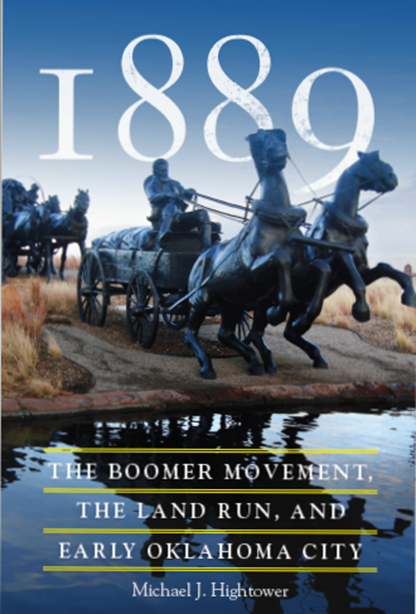
1889: The Boomer Movement, the Land Run, and Early Oklahoma City
History / University of Oklahoma Press, 2018
2019 nonfiction finalist, Oklahoma Book Awards, a program of the Oklahoma Center for the Book, an affiliate of the Library of Congress
1889 chronicles central Oklahoma's uphill battle to attain territorial status and urban pioneering in what became Oklahoma City. Michael frames his story within the larger history of Old Oklahoma where displaced tribes and freedmen, wealthy cattlemen, townsite developers, and prospective homesteaders faced off in disputes, sometimes peaceful but often not, over the federal government’s public lands policies. Oklahoma’s story is profoundly American, and it reveals the region as a crucible of competing interests and visions of the future with deep roots in U.S. history.
What readers and reviewers have to say...
I have just finished the wonderful book “1889” by Michael Hightower (published 2018). It comprehensively tells our city’s origin story from 1866 through 1890 in a way that turned the mythical into something very real and accessible. Highly recommended for any resident of OKC.
David Holt
Mayor of Oklahoma City
Instagram post, July 10, 2021
1889 is a welcome addition to the existing literature on the historical development of Oklahoma. Written in an accessible and engaging style, the book will be useful in undergraduate and graduate seminars and should be well received by nonacademics wishing to better understand the political and economic context of opening Oklahoma to non-Native people. Hightower’s account of the contested settlement of the Unassigned Lands within the larger political and economic context of the Gilded Age offers new interpretations of the history of Oklahoma.
Douglas A. Hurt
University of Missouri
Reviewed in Journal of Southern History
In his skillful use of newspapers, archival sources, correspondence, memoirs and more, along with generous illustrations, Hightower successfully demonstrates “that the boomer movement was more nuanced” than historians have typically characterized it. At times, however, the compendium-like approach of incorporating a plethora of details and identifying countless individuals, mainly white men, detracts from gaining a broader sense of his themes. Nevertheless, 1889 is a fascinating window onto a crucial event in US and Great Plains history.
Ginette Aley
Kansas State University
Reviewed in Agricultural History
1889 is a much-needed contribution to the history of Oklahoma, the American West, and Gilded Age America. Michael J. Hightower offers the best and most complete coverage of the Boomer movement that I have read.
Sterling Evans
Editor of
Farming across Borders: A Transnational History of the North
American West
This book is the best available about the opening of the Unassigned Lands of Oklahoma. Michael Hightower incorporates diverse sources to provide a coherent story, often challenging prior histories and enriching all… As one who has written on Oklahoma history for more than forty years, I wish I had written this book.
Alvin O. Turner
East Central Oklahoma University
(Emeritus)
Reviewed in Western Historical Quarterly
Hightower’s analysis of how Oklahoma’s foundation story symbolized Gilded Age American politics is enmeshed in a fascinating narrative of frontier settlement life. His outstanding storytelling ability generates an entertaining yet thought-provoking book.
Julie Hufstetler
Oklahoma Wesleyan University
Reviewed in Great Plains Quarterly
Hightower uses the oral histories well and allows people’s voices to provide additional rich detail to newspaper accounts and government reports. In sum, this lively book will work well in undergraduate and graduate classes, both in terms of providing background about early Oklahoma history and the Gilded Age more broadly, but also as a way for students to think about how to use oral histories in their own projects.
Evan C. Rothera
University of Arkansas at Fort
Smith
Reviewed in Oral History Review